
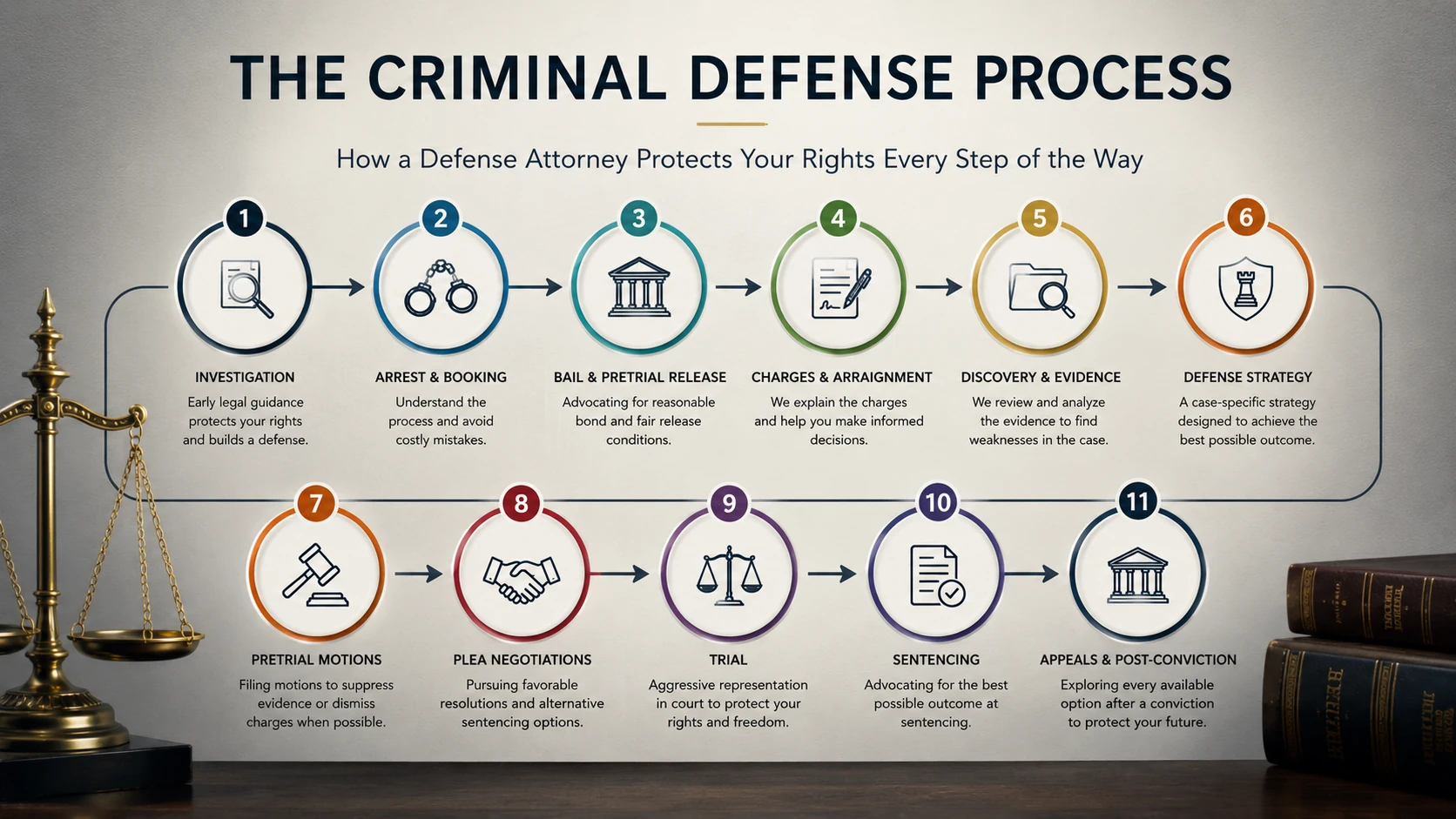
Being accused of a crime can create immediate uncertainty about your freedom, reputation, career, family, and future. You may have questions about what happens after an arrest, whether you should speak with the police, how long the case will take, and what a criminal defense attorney can actually do to help.
The criminal defense process involves much more than appearing in court. A strong defense may begin before formal charges are filed and continue through an investigation, arrest, bond hearing, evidence review, negotiations, trial, sentencing, or appeal.
Every criminal case is different, but understanding the major stages can help you avoid costly mistakes and make better-informed decisions. A defense attorney’s role is to protect your constitutional rights, evaluate the evidence, challenge weaknesses in the prosecution’s case, and guide you through each stage with a strategy tailored to your circumstances.
The following overview explains how the criminal defense process generally works and how an attorney can protect you from the first investigation through the final resolution of your case.
What Is the Criminal Defense Process?
The criminal defense process is the series of legal proceedings that occurs when a person is investigated, arrested, or charged with a crime.
Depending on the circumstances, the process may include:
- A law enforcement investigation
- Questioning or execution of a search warrant
- Arrest and booking
- Bail or bond proceedings
- Formal charging
- Arraignment
- Evidence review and discovery
- Pretrial motions
- Plea negotiations
- Trial
- Sentencing
- Appeals or post-conviction proceedings
Not every case goes through every stage. Some investigations end without charges. Some cases are dismissed after evidence is reviewed or challenged. Others may be resolved through negotiation, a diversion program, or trial.
The exact path depends on factors such as the alleged offense, the evidence, the defendant’s criminal history, the jurisdiction, and the strength of the available defenses.
At The O’Donnell Law Firm, the defense process is built around preparation, direct communication, and a case-specific strategy rather than a one-size-fits-all formula.
Stage 1: The Criminal Investigation
A criminal case often begins before an arrest. Law enforcement officers may receive a report, interview witnesses, review video footage, collect physical evidence, examine digital records, or seek a search or arrest warrant.
In some cases, a person may not realize they are under investigation until a detective calls and asks to schedule an interview. In others, officers may arrive at a home or workplace with a warrant.
The investigation stage can be one of the most important points at which to involve a criminal defense attorney.
Your Right to Remain Silent
People often believe that cooperating fully with investigators will make the problem go away, particularly when they believe they have done nothing wrong. However, statements can be misunderstood, taken out of context, or compared against evidence the person has not seen.
You generally have the right to decline to answer questions that could incriminate you. Remaining silent is not the same as obstructing an investigation. It is the exercise of a constitutional protection.
Rather than attempting to explain the situation on your own, you can state that you wish to remain silent and would like to speak with an attorney.
Your Right to an Attorney
You have the right to seek legal counsel when you are being questioned or investigated. You do not have to wait until an arrest or formal charge to contact a lawyer.
An attorney can communicate with investigators on your behalf, clarify whether you are considered a witness or suspect, and advise you about whether participating in an interview is in your best interest.
How a Defense Attorney Helps During an Investigation
Early legal intervention may give the defense an opportunity to act before evidence disappears, memories fade, or investigators settle on a single theory.
A defense attorney may:
- Communicate with law enforcement on your behalf
- Advise you before any interview or questioning
- Determine whether a warrant has been issued
- Preserve messages, video footage, records, or witness information
- Review the circumstances surrounding a search
- Identify weaknesses in the allegations
- Present relevant information to investigators or prosecutors
- Prepare for the possibility that charges will be filed
The firm’s criminal defense process emphasizes collecting facts early and helping clients understand what may happen next.
Stage 2: Arrest and Booking
An arrest occurs when law enforcement takes a person into custody. After an arrest, the person may be transported to a jail or processing facility for booking.
Booking commonly includes:
- Recording identifying information
- Fingerprinting
- Taking photographs
- Conducting a search
- Documenting the alleged charge
- Checking for outstanding warrants
- Collecting and storing personal property
An arrest is not a conviction. The prosecution must still prove the allegations through the criminal court process.
What to Do After an Arrest
The safest steps after an arrest are usually to remain calm, avoid resisting, limit what you say, and request an attorney.
Do not assume that informal conversations with officers are off the record. Statements made during transportation, booking, or while waiting in custody may later be included in reports or used as evidence.
You should also be cautious when speaking with friends or relatives from jail. Jail calls are frequently recorded and may be reviewed by prosecutors.
Common Mistakes to Avoid After an Arrest
A person facing criminal accusations should generally avoid:
- Trying to talk their way out of the arrest
- Giving a detailed statement without legal advice
- Discussing the facts during a recorded jail call
- Posting about the case on social media
- Deleting messages, photographs, or other potential evidence
- Contacting an alleged victim or witness
- Asking someone else to contact a witness
- Violating a protective order or bond condition
Even actions that seem harmless can complicate the defense or result in additional allegations.
How a Defense Attorney Protects You After an Arrest
A defense attorney can obtain information about the alleged charge, explain the next steps, prepare for a bond hearing, and begin evaluating the evidence.
The attorney may also communicate with family members, gather information needed for release, and advise the client about avoiding further legal problems while the case is pending.
Stage 3: Bail, Bond, and Pretrial Release
After an arrest, a judge or magistrate may determine whether the defendant can be released while the case is pending.
The terms “bail” and “bond” are often used interchangeably, although they can refer to different aspects of the release process. The amount and conditions may depend on the charge and the person’s individual circumstances.
Factors That May Affect Bond
A court may consider:
- The seriousness of the alleged offense
- Whether the charge involves violence
- The person’s prior criminal history
- Previous failures to appear in court
- Family and community ties
- Employment history
- The alleged risk to another person
- The likelihood that the defendant will return to court
- Immigration or citizenship considerations
- Whether other charges or warrants are pending
Common Conditions of Release
Pretrial release may include conditions such as:
- Attending all required court appearances
- Avoiding contact with an alleged victim
- Remaining within a specific geographic area
- Surrendering a passport
- Avoiding alcohol or controlled substances
- Submitting to drug or alcohol testing
- Installing an ignition interlock device
- Wearing a GPS monitor
- Following a curfew
- Avoiding possession of firearms
- Complying with a protective order
Violating a condition may result in bond revocation, additional charges, or more restrictive release terms.
How a Defense Attorney Can Help With Bond
A defense attorney may advocate for a reasonable bond and present information showing that the client has stable employment, family support, community ties, and a history of appearing in court.
Counsel may also request that unreasonable or unnecessarily restrictive conditions be modified.
Stage 4: Formal Charges and Arraignment
An arrest and a formal criminal charge are related but separate events. Prosecutors review the available information and decide which charges, if any, to pursue.
The charging procedure varies depending on whether the case involves a misdemeanor, felony, state offense, or federal allegation.
At an arraignment or initial plea setting, the defendant is informed of the charge and asked to enter a plea.
Common Plea Options
The available pleas may include:
- Not guilty
- Guilty
- No contest, when legally available
A not-guilty plea does not necessarily mean the defendant is claiming that nothing happened. It preserves the person’s rights and requires the prosecution to prove the case.
Why a Plea Decision Matters
Entering a plea can affect the entire direction of the case. A conviction may carry consequences beyond jail, fines, or probation.
Depending on the charge, additional consequences may involve:
- Employment
- Professional licensing
- Housing
- Education
- Immigration status
- Firearm rights
- Driving privileges
- Child custody proceedings
- Reputation
- Future background checks
A defendant should understand both the immediate and long-term consequences before accepting any resolution.
The Attorney’s Role at Arraignment
A criminal defense attorney can advise the client about the appropriate plea, address release conditions, confirm future court dates, and begin setting deadlines for evidence review and pretrial litigation.
Stage 5: Discovery and Evidence Review
Discovery is the process through which the defense obtains and reviews evidence related to the prosecution’s case.
This stage is essential because allegations in a charging document do not necessarily present the full story. The defense must examine what the evidence actually shows, how it was obtained, and whether it is reliable.
Common Types of Evidence in Criminal Cases
Discovery may include:
- Police reports
- Body-camera footage
- Dash-camera video
- Surveillance recordings
- Emergency call recordings
- Witness statements
- Photographs
- Medical records
- Laboratory reports
- Drug or alcohol test results
- Search warrant affidavits
- Phone records
- Text messages
- Emails
- Social media content
- Location data
- Financial records
- Expert reports
The evidence may look very different depending on the accusation. For example, a drug crime defense may focus heavily on the legality of a search, who controlled the location where the substance was found, and how officers collected and tested the alleged drugs.
A violent crime defense may require close analysis of witness accounts, medical evidence, video footage, self-defense issues, and the sequence of events.
How a Defense Attorney Reviews the Evidence
A defense attorney does not simply read the police report and accept its conclusions. The attorney compares the report against recordings, witness statements, timelines, physical evidence, and applicable law.
The review may identify:
- Conflicting witness statements
- Missing video footage
- Gaps in the timeline
- Unsupported assumptions
- Problems with identification
- Improper police procedures
- Inaccurate laboratory testing
- Evidence that was not preserved
- Statements obtained unlawfully
- Facts that support an alternative explanation
Small inconsistencies can become significant when the prosecution must prove every required element of an offense.
Conducting an Independent Investigation
The defense may need to conduct an investigation separate from the one performed by law enforcement.
That work may include:
- Interviewing witnesses
- Visiting the location
- Obtaining private surveillance footage
- Reviewing phone or location records
- Consulting medical or forensic experts
- Examining photographs
- Reconstructing a timeline
- Identifying potential alibi evidence
- Preserving social media or digital communications
A careful independent review can uncover information that was missed, misunderstood, or never pursued by investigators.
Stage 6: Developing the Defense Strategy
A criminal defense strategy should be based on the facts, law, evidence, potential penalties, and the client’s goals.
There is no universal defense that applies to every allegation. Two people charged under the same statute may need completely different strategies because the evidence and circumstances are different.
Potential Criminal Defense Strategies
Depending on the case, a defense may involve:
- Mistaken identity
- False accusations
- Lack of intent
- Lack of knowledge
- Alibi
- Self-defense
- Defense of another person
- Insufficient evidence
- Unreliable witness testimony
- Improper identification procedures
- Unlawful search or seizure
- Involuntary or improperly obtained statements
- Entrapment
- Consent
- Failure to prove possession
- Failure to prove every element of the offense
The goal is not simply to identify a legal theory. The attorney must connect the defense to admissible evidence and present it in a way that can withstand scrutiny.
Why Case-Specific Strategy Matters
Template-based defense work can overlook the details that determine how a case should be handled.
A strategic defense considers questions such as:
- What can the prosecution actually prove?
- Which witnesses are credible?
- Was the evidence lawfully obtained?
- Are recordings consistent with written reports?
- Is favorable evidence missing?
- Are there grounds to exclude evidence?
- What are the risks of trial?
- Are there alternatives to conviction?
- What outcome best protects the client’s future?
The O’Donnell Law Firm’s approach is built around direct communication, detailed preparation, and strategies shaped around the individual client rather than a standard formula.
Stage 7: Pretrial Motions and Court Hearings
Before trial, the defense may file motions asking the court to resolve legal or evidentiary issues.
Pretrial motions can influence what evidence the jury is allowed to hear and, in some cases, may significantly weaken the prosecution’s case.
Motion to Suppress Evidence
A motion to suppress asks the court to exclude evidence obtained in violation of the law or the defendant’s constitutional rights.
This may involve allegations that:
- A traffic stop was not legally justified
- Officers searched a vehicle without sufficient legal authority
- A home was searched under an invalid warrant
- The search exceeded the scope of the warrant
- A statement was obtained after the right to counsel was invoked
- A confession was involuntary
- Evidence was seized without probable cause
When important evidence is suppressed, prosecutors may have to reduce the charge, reconsider their position, or dismiss the case.
Motion to Dismiss
A motion to dismiss may be appropriate when there is a legal defect, insufficient charging language, a violation of certain rights, or another recognized basis for dismissal.
Not every weakness in the evidence supports a formal motion to dismiss. In many cases, factual weaknesses are addressed through negotiation or trial.
Other Pretrial Motions
Other motions may seek to:
- Exclude unreliable expert testimony
- Prevent improper character evidence
- Require disclosure of evidence
- Limit prejudicial photographs or statements
- Obtain records
- Compel preservation of evidence
- Challenge identification procedures
- Separate charges or defendants
- Address prior convictions
- Establish what evidence may be introduced at trial
These hearings allow the defense to challenge the prosecution’s methods before the case reaches a jury.
Stage 8: Plea Negotiations and Alternative Resolutions
Many criminal cases are resolved without a trial. However, a plea offer should not be accepted simply because it is available.
A defense attorney must evaluate the strength of the state’s case, the available defenses, the potential punishment, and the long-term consequences of the proposed agreement.
What Is a Plea Agreement?
A plea agreement is a negotiated resolution between the prosecution and defense. It may involve:
- Reducing the charge
- Dismissing one or more counts
- Recommending a particular sentence
- Avoiding a mandatory penalty
- Agreeing to probation
- Completing treatment or education
- Paying restitution
- Satisfying other court-ordered conditions
The judge may need to approve the agreement and is not always required to accept every recommendation.
Possible Alternatives to Trial
Depending on the charge, jurisdiction, history, and eligibility requirements, possible outcomes may include:
- Pretrial diversion
- Deferred adjudication
- Community supervision
- Treatment programs
- Educational programs
- Reduction to a lesser charge
- Dismissal after completing conditions
- Negotiated sentencing
- Time served
Availability is never guaranteed, and each option can have legal consequences that should be reviewed carefully.
How an Attorney Evaluates an Offer
A criminal defense attorney should explain:
- What the prosecution is offering
- What rights the client would give up
- The direct penalties
- The collateral consequences
- The likelihood of success at trial
- The maximum possible punishment
- Whether the agreement could affect immigration or licensing
- Whether the case may later qualify for sealing or expunction
- What happens if the client violates the agreement
The final decision belongs to the client, but it should be made with a clear understanding of the risks and alternatives.
Stage 9: Preparing for Trial
When a case cannot be dismissed or resolved through an acceptable agreement, it may proceed to trial.
Trial preparation often begins long before the trial date. Effective preparation includes reviewing every piece of evidence, developing witness examinations, preparing exhibits, researching legal issues, and anticipating the prosecution’s strategy.
Jury Selection
In a jury trial, attorneys question potential jurors to identify bias, conflicts, or experiences that may affect their ability to evaluate the case fairly.
The goal is not to select jurors who automatically favor one side. It is to identify a panel that can follow the law and evaluate the evidence impartially.
Opening Statements
Opening statements provide each side with an opportunity to explain what they believe the evidence will show.
The prosecution typically presents its theory first. The defense may respond immediately or reserve its opening until later, depending on the strategy and court rules.
The Prosecution’s Evidence
The prosecution presents witnesses, recordings, physical evidence, expert opinions, and other material intended to establish guilt.
The defense has the opportunity to cross-examine witnesses, challenge their recollection, expose inconsistencies, question investigative methods, and test the reliability of the evidence.
The Prosecution’s Burden of Proof
The prosecution must prove every required element of the charged offense beyond a reasonable doubt.
The defendant does not generally have to prove innocence. The defense may focus on showing that the prosecution’s evidence is incomplete, inconsistent, unreliable, or legally insufficient.
The Defense Case
Depending on the strategy, the defense may present:
- Witness testimony
- Expert opinions
- Photographs or recordings
- Digital evidence
- Medical evidence
- Alibi evidence
- Character evidence when permitted
- Evidence supporting self-defense or another legal defense
A defendant also has the right not to testify. The decision should be made after careful discussion with counsel.
Closing Arguments and Verdict
After the evidence is presented, each side gives a closing argument.
The judge then instructs the jury on the applicable law. The jury deliberates and returns a verdict. Depending on the jurisdiction and type of case, the verdict may need to be unanimous.
Stage 10: Sentencing
If the defendant is convicted at trial or enters a plea, the case proceeds to sentencing.
Sentencing may occur immediately or at a later hearing.
Potential Criminal Penalties
Depending on the offense, penalties may include:
- Jail
- Prison
- Fines
- Probation
- Community service
- Restitution
- Treatment
- Classes
- Electronic monitoring
- Driver’s license consequences
- Registration requirements
- Restrictions on firearm possession
Sentencing rules vary significantly based on the charge, criminal history, enhancement allegations, and applicable statutes.
How a Defense Attorney Advocates at Sentencing
The defense can present mitigating information that helps the court understand the client as a complete person rather than only through the allegation.
Mitigating evidence may involve:
- Employment history
- Family responsibilities
- Military service
- Medical circumstances
- Mental health treatment
- Substance abuse treatment
- Educational accomplishments
- Community involvement
- Lack of prior convictions
- Acceptance of responsibility
- Restitution efforts
- Letters of support
An attorney may ask for a lower sentence, probation, treatment, or another outcome that addresses both the legal issues and the client’s future.
Stage 11: Appeals and Post-Conviction Options
A conviction does not always end the legal process. Depending on the circumstances, a defendant may have the right to pursue an appeal or another form of post-conviction relief.
What Is a Criminal Appeal?
An appeal usually asks a higher court to review legal errors that occurred in the trial court.
An appeal is not typically a new trial. The appellate court reviews the record to determine whether an error affected the defendant’s rights or the outcome.
Potential appellate issues may involve:
- Improper admission of evidence
- Incorrect jury instructions
- Insufficient evidence
- Constitutional violations
- Improper prosecutorial arguments
- Errors in sentencing
- Improper denial of a defense motion
Other Post-Conviction Remedies
Depending on the case, options may include:
- A motion for a new trial
- Direct appeal
- Habeas corpus proceedings
- Sentence modification
- Community supervision modifications
- Record sealing
- Expunction
- Challenges based on newly discovered evidence
These remedies have strict legal requirements and are not available in every case.
Why Deadlines Matter
Appeal and post-conviction deadlines can be extremely short. Missing a filing deadline may eliminate an otherwise valid option.
A person considering an appeal should seek legal guidance as soon as possible after the judgment or sentence.
How a Criminal Defense Attorney Protects Your Rights
A defense attorney’s work extends across every stage of the criminal case.
The attorney serves as an advocate, advisor, investigator, negotiator, and courtroom representative.
Protecting Your Constitutional Rights
A criminal defense lawyer examines whether law enforcement respected rights involving:
- Searches and seizures
- Questioning
- Legal counsel
- Due process
- Confronting witnesses
- Compulsory process
- A fair trial
- Protection against self-incrimination
When a violation occurs, the attorney may challenge the evidence or seek another legal remedy.
Preventing Costly Mistakes
One of the most important services an attorney provides is helping clients avoid actions that could make the case worse.
That includes guidance about:
- Police interviews
- Social media
- Witness contact
- Recorded calls
- Bond conditions
- Court appearances
- Evidence preservation
- Plea decisions
- Testifying
Clear legal advice can prevent a moment of panic or confusion from creating lasting consequences.
Challenging the Prosecution’s Case
Defense counsel reviews whether the state can prove each element of the charge and whether its evidence is admissible and reliable.
This may involve challenging:
- The legality of a search
- Witness credibility
- Identification procedures
- Forensic testing
- Police reports
- Expert conclusions
- Digital evidence
- The alleged timeline
- The prosecution’s interpretation of events
Explaining Your Options
The criminal court system can be difficult to understand, especially when decisions must be made under pressure.
An attorney should explain:
- What the charge means
- What the prosecution must prove
- What will happen at each court setting
- The possible penalties
- The available defenses
- The risks of trial
- The consequences of a plea
- The next recommended steps
Clients should be able to make informed decisions rather than feeling pushed through an unfamiliar system.
Pursuing the Best Available Resolution
The appropriate objective depends on the facts and the client’s situation.
Possible goals may include:
- Preventing charges from being filed
- Dismissal
- Suppression of evidence
- Reduction of charges
- Diversion
- Deferred adjudication
- Favorable probation terms
- Acquittal at trial
- Reduced sentencing exposure
- Preservation of employment or licensing opportunities
No attorney can guarantee a specific outcome, but thorough preparation can improve the defense’s ability to identify and pursue the strongest available path.
When Should You Contact a Criminal Defense Attorney?
You do not need to wait until formal charges are filed.
Consider contacting an attorney immediately when:
- A detective asks to interview you
- Police search your home, vehicle, or workplace
- You learn that you are the subject of an investigation
- Someone has accused you of a crime
- You believe a warrant may have been issued
- You have been arrested
- You have received a court date
- Bond conditions are interfering with your work or family
- Prosecutors have offered a plea agreement
- You believe your rights were violated
- You are worried that evidence may disappear
The earlier an attorney becomes involved, the more opportunity there may be to preserve evidence, prevent damaging statements, and influence the direction of the case.
Frequently Asked Questions About the Criminal Defense Process
How Long Does the Criminal Defense Process Take?
A criminal case may take weeks, months, or longer. The timeline depends on the severity of the charge, the volume of evidence, court scheduling, laboratory testing, motion hearings, negotiations, and whether the case proceeds to trial.
A faster resolution is not always a better resolution. The defense may need sufficient time to investigate, obtain records, consult experts, and challenge the prosecution’s evidence.
Can Criminal Charges Be Dismissed Before Trial?
Yes, charges may sometimes be dismissed before trial.
Possible reasons may include insufficient evidence, unavailable witnesses, unreliable testimony, legal defects, successful suppression of evidence, completion of a diversion program, or a prosecutor’s decision that the case should not proceed.
Dismissal is never automatic and depends on the facts and law.
Should I Speak to the Police if I Am Innocent?
Innocent people can still make statements that are misunderstood, incomplete, or inconsistent with information they have not seen.
Before answering investigative questions, it is generally wise to seek legal advice. An attorney can help determine whether an interview is appropriate and can communicate with investigators on your behalf.
Does Hiring a Criminal Defense Attorney Make Me Look Guilty?
No. Seeking counsel is the exercise of a constitutional right.
Investigators and prosecutors regularly interact with defense attorneys. Hiring a lawyer does not admit guilt. It helps protect the fairness of the process.
Will My Criminal Case Go to Trial?
Not necessarily. Many cases are dismissed, reduced, diverted, or resolved through negotiation.
A defense attorney should still prepare carefully because strong trial preparation may improve the client’s negotiating position and ensure the case is ready if an acceptable resolution cannot be reached.
What Should I Bring to My First Meeting With an Attorney?
Useful information may include:
- Bail or bond paperwork
- Court notices
- Charging documents
- Police reports
- Search warrant documents
- Relevant text messages or emails
- Photographs or video
- Witness names
- A written timeline
- Employment or licensing information
- Prior court records
- Conditions of release
Do not delete, alter, or post potential evidence. Preserve it and discuss it privately with your attorney.
Speak With a Houston Criminal Defense Attorney
The decisions made during the earliest stages of a criminal case can affect everything that follows. Statements to investigators, contact with witnesses, evidence preservation, and compliance with bond conditions can all influence the defense.
The O’Donnell Law Firm provides structured guidance, direct communication, and strategic representation for people facing criminal accusations in Houston and the surrounding area. Attorney Jim O’Donnell draws on more than a decade of experience within the Harris County District Attorney’s Office to evaluate how the prosecution may approach a case and where its evidence may be challenged.
Learn more about The O’Donnell Law Firm and its approach to protecting clients throughout the criminal defense process.
If you are under investigation, have been arrested, or are facing criminal charges, contact The O’Donnell Law Firm to discuss your situation and the next steps available to you.
This article is provided for general informational purposes and does not constitute legal advice. Criminal procedures and available defenses depend on the facts, jurisdiction, and applicable law. Consult a qualified attorney regarding your specific situation.